A short Bodrum sketch
The Matter of Raşid’s Lemons
A short Bodrum sketch from the world of What Remains Unsaid
People, unfortunately, were more complicated.
Raşid had not intended to begin the day as a victim.
He had intended to drink one small glass of tea on the terrace, inspect the lemon tree, remove two dead leaves from the hibiscus, and return indoors before the sun became unreasonable. It was a modest plan, and like most modest plans in Torba, it had depended upon other people not interfering.
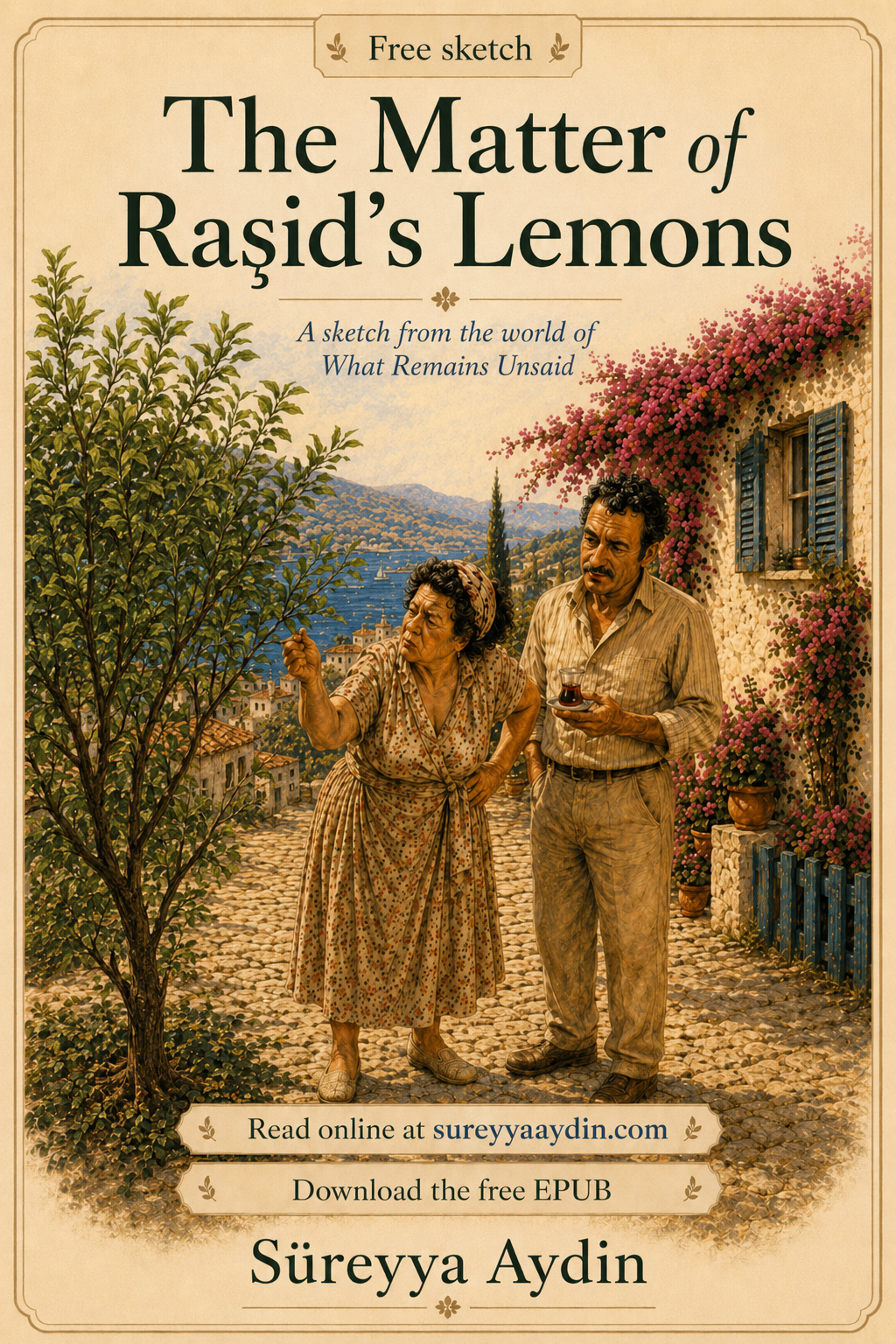
The lemon tree stood in the corner of his garden, between the low stone wall and the outside tap. It was not impressive to anyone who did not understand lemons. Its branches twisted in different directions, with an awkwardness that Raşid privately admired. But it produced large, bright, heavy lemons, the sort that made neighbours pause at the gate and say, with unnecessary casualness, ‘Maşallah, Raşid Bey, this year the tree is very generous.’
The tree had been generous.
Now it was bare.
Raşid stood in front of it with his tea cooling in one hand. He looked at the empty branches. He looked at the ground. He looked at the wall.
There were three lemon leaves on the path, two short green stems, and the unmistakable impression that somebody had been efficient.
Behind him, the kitchen door opened.
‘You are standing very still,’ Ferhunde said.
Raşid did not turn round.
‘It is a new approach to gardening.’
Ferhunde came down the steps in her slippers, carrying the expression she used for household discoveries, moral disappointments and medical news found on the internet.
‘What has happened?’
Raşid pointed at the tree.
Ferhunde stared at it.
‘Where are the lemons?’
‘That, my dear sister,’ said Raşid, ‘is the question which has caused me to stand very still.’
Ferhunde came closer. She walked around the tree once, slowly, as if it were a relative whose story she did not quite believe.
‘All of them?’
‘Unless they are hiding.’
‘This is not funny.’
‘I did not say it was funny. I only said they may have developed a sense of privacy.’
Ferhunde bent to examine the leaves on the path.
‘They have been cut.’
‘So they were not taken by sentimental birds.’
‘Who would do this?’
‘Someone with a bag,’ said Raşid. ‘Possibly a basket. A person of organisation.’
Ferhunde straightened. ‘You must not be too calm about this.’
‘I am not calm. I am conserving energy.’
‘These were your lemons. You have been talking about them for weeks.’
‘I had noticed.’
‘Your best ones.’
‘I had noticed that too.’
Ferhunde looked over the wall towards the lane. The morning was already warming. Somewhere beyond the next house, a dog barked once and was corrected by somebody’s grandmother.
‘This is what happens,’ Ferhunde said, ‘when people no longer understand boundaries.’
Raşid looked at the low wall, which was roughly the height of a determined child.
‘The boundary was perhaps only symbolic.’
‘A wall is a wall.’
‘In Torba,’ said Raşid, ‘a wall is a suggestion.’
Ferhunde ignored this, which Raşid took as a sign that she had understood it perfectly.
‘We must think carefully,’ she said.
‘Must we?’
‘Yes. One should not accuse without evidence.’
Raşid looked again at the empty tree.
‘It is true. The lemons may have left voluntarily.’
‘Raşid.’
He inclined his head.
Ferhunde lowered her voice, although there was nobody else in the garden. ‘Has anyone been asking about them?’
‘Everyone asks about them.’
‘Recently.’
‘Emine said last week they were very handsome.’
Ferhunde became still.
Raşid saw this and looked back at the tree.
‘Ferhunde.’
‘I have not said anything.’
‘You have said several things with your face.’
‘I am only remembering.’
‘Remember more quietly.’
At that moment the bell at the gate gave two short rings and then a third, longer one.
Ferhunde closed her eyes.
‘That will be Emine.’
‘A coincidence,’ said Raşid.
‘Do not start.’
Emine came through the gate without waiting, carrying a cloth bag on one arm and a glass bottle in the other hand. The bottle had a ribbon tied round its neck. Inside it was pale yellow liquid with slices of lemon floating near the top.
‘Good morning,’ she called. ‘I brought lemonade.’
Ferhunde and Raşid looked at the bottle.
Emine beamed at them.
‘Fresh,’ she said. ‘This morning.’
Raşid took a slow sip of cold tea.
Ferhunde’s face arranged itself into hospitality with difficulty.
‘How kind.’
‘I made too much,’ Emine said, coming closer. ‘And I thought, Ferhunde looks tired lately. Not old. Tired. There is a difference.’
‘Thank you,’ said Ferhunde.
‘Lemon is very good for the body,’ Emine said. ‘Even arguments, if people drink enough.’
Raşid looked at his tree.
‘That is useful information.’
Emine followed his gaze. ‘Ah. Your tree.’
‘Yes,’ said Raşid. ‘My tree.’
‘Very nice tree.’
‘It was having a good year.’
Ferhunde took the bottle from Emine. ‘You have been busy this morning.’
‘Very busy. I woke early because of Gül Hanım’s rooster.’
Raşid looked at Ferhunde. Ferhunde looked back at him. For one moment, their expressions were identical. People had always said they looked nothing alike until they disapproved of something.
Emine did not notice. She had opened her bag and was removing a small plate covered with foil.
‘I also brought cake. Not very sweet, I’m afraid.’
‘Emine,’ Ferhunde said, still holding the bottle, ‘where did you get so many lemons?’
‘From the tree.’
Raşid coughed once.
Ferhunde’s fingers tightened round the neck of the bottle.
‘Which tree?’
‘Gül Hanım’s, of course.’
Ferhunde paused.
Raşid looked at the empty branches again, but this time with interest.
‘Gül Hanım’s tree,’ Ferhunde repeated.
‘Yes. It hangs over my side. Almost into my breakfast. What am I supposed to do? Let them rot? In this heat, waste is a sin.’
‘Did Gül Hanım give permission?’
‘For the ones on my side?’ Emine looked genuinely puzzled. ‘They are already in my garden.’
‘They are still her lemons.’
‘Only originally.’
Raşid made a small sound. It might have been a cough. It might have been the beginning of an opinion wisely abandoned.
Ferhunde gave him a warning glance.
‘Emine,’ she said, ‘fruit does not change ownership because it hangs over a wall.’
‘If I have to duck under it,’ said Emine, ‘then it is participating in my life.’
Raşid looked down at his tea.
Ferhunde seemed to consider several replies and reject all of them.
Emine noticed at last that something in the garden was not quite ordinary.
‘Where are your lemons?’
Neither twin answered immediately.
‘That,’ said Ferhunde, ‘is what we are discussing.’
Emine stared at the tree.
‘All gone?’
‘All gone.’
‘Ay, Raşid Bey.’
‘Indeed.’
‘How terrible.’
‘A difficult morning for citrus.’
Emine moved closer to the tree, still holding the foil-covered cake.
‘Maybe the wild pigs took them.’
There was a silence.
Ferhunde turned her head slowly towards Raşid.
Raşid turned his head slowly towards Ferhunde.
‘Pigs do not climb lemon trees,’ said Ferhunde.
‘Nor use secateurs,’ said Raşid.
Emine looked from one to the other.
‘They are clever.’
‘Not in that way,’ said Ferhunde. She put the lemonade down beside the tree. ‘Look at the stems. They have been cut cleanly.’
Emine leaned in. ‘Yes. Very clean.’
She looked from Ferhunde to Raşid. ‘You two are very certain.’
‘We are certain,’ said Ferhunde, ‘because we are not mad.’
‘That is not always the reason people are certain.’
Raşid gave Emine a look of mild respect. She had, for once, said something almost profound without knowing it.
Ferhunde had begun walking towards the wall, inspecting the top stones.
‘Someone came in from the lane.’
‘Or from next door,’ Emine said.
‘Next door is empty.’
‘Then from the lane.’
‘Thank you.’
‘Perhaps children.’
‘Children would take three lemons,’ said Raşid. ‘Four if badly raised. They would not strip the tree.’
‘Foreign renters?’ Emine asked.
Ferhunde hesitated. This was clearly attractive.
Raşid saw the temptation and intervened.
‘Even foreign renters usually require breakfast before organised crime.’
Emine nodded. ‘Also they would not know which lemons are good. They would take the ugly ones too.’
‘There were no ugly ones,’ said Raşid.
Ferhunde glanced at him. It was the first moment that morning in which his irritation showed plainly.
Emine softened. ‘Of course not, Raşid Bey. Your lemons are famous.’
‘They are not famous.’
‘They are discussed.’
‘That is different.’
‘In Torba, it is the same.’
Ferhunde picked up one of the cut stems from the path and held it as if it were evidence in a court where she had already appointed herself judge.
‘This was done by someone who knew what they were doing.’
Raşid looked towards the gate. A small white van had stopped briefly in the lane, then moved on.
Emine uncovered the cake and placed it beside the lemonade.
‘At least we have something to drink while we think.’
Ferhunde looked at the bottle.
Raşid looked at the bottle.
Emine, who saw nothing troubling in this, poured three glasses of cloudy lemonade with mint leaves floating on the surface.
Ferhunde took a cautious sip.
It was, unfortunately, excellent.
Raşid drank his more slowly.
‘Well?’ Emine said.
‘It is very good,’ Ferhunde admitted.
‘Of course. Gül Hanım’s lemons are not as large as Raşid Bey’s, but they have flavour.’
‘How consoling,’ said Raşid.
Emine smiled. ‘You see? Already you are less upset.’
‘No,’ said Raşid.
Ferhunde sat down with her glass and the little green stem.
‘We should ask discreetly.’
‘Ask whom?’ said Raşid.
‘People.’
‘A dangerous category.’
‘Someone must have seen something.’
‘Someone always sees something,’ Emine said. ‘The question is whether they understood it at the time.’
Again, Raşid looked at her with unwilling respect.
Before Ferhunde could answer, a woman’s voice called from the lane.
‘Ferhunde Hanım!’
They all turned.
A neighbour was passing the gate with a shopping bag in each hand. She did not come in, which Ferhunde considered one of her better qualities.
‘Have you been to the market this morning?’ the neighbour called.
‘Not yet,’ Ferhunde said.
‘There is a new couple there, near the olives. Fresh lemon juice. Very nice. Huge lemons.’ She adjusted one of the bags on her wrist. ‘Really huge, Raşid Bey. Just like yours.’
She lifted her hand and continued down the lane before anyone had answered.
The three of them stood in the garden.
The lemon tree gave no assistance.
Emine lowered her glass.
‘Ah.’
Ferhunde looked at Raşid.
Raşid looked at the bare branches, then at the cut stems, then at the bottle of lemonade sitting innocently in the sun.
‘It is always pleasant,’ he said, ‘to support local enterprise.’
Emine frowned. ‘But we haven’t bought any.’
Ferhunde closed her eyes.
Raşid finished his lemonade.