A short Bodrum sketch
Ferhunde and the Unnecessary Börek
A short Bodrum sketch from the world of What Remains Unsaid
In Ferhunde’s case, she also brings börek.
Ferhunde had never believed in arriving quietly when sympathy was required. A quiet entrance suggested uncertainty, and uncertainty was no basis for condolence.
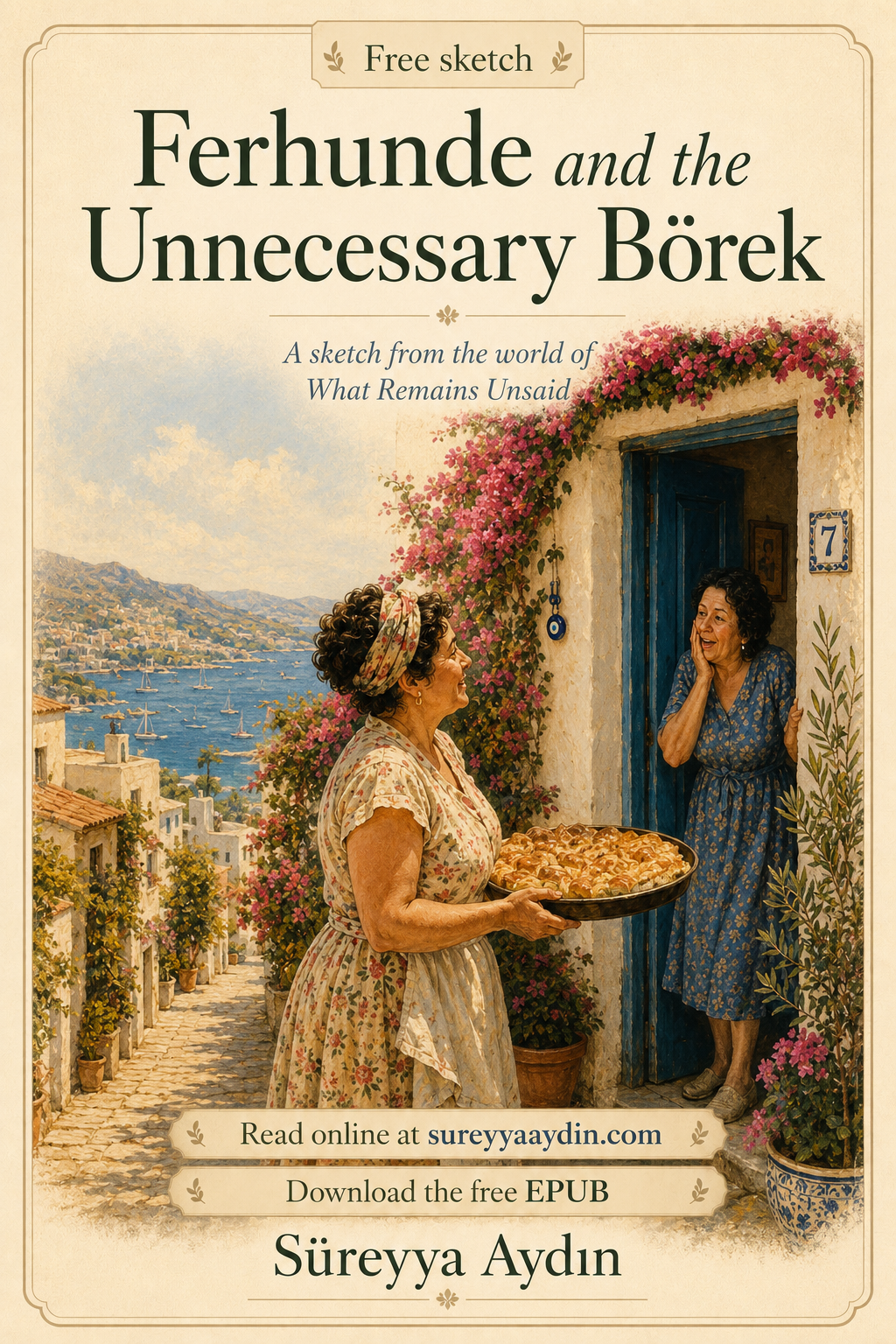
By half past ten, she was already at the garden gate of Gül Hanım’s villa, carrying a covered tray in both hands and pressing the bell with her elbow. She had dressed carefully for the occasion: her new floral dress, her smartest apron tied firmly at the waist, and shoes chosen less for elegance than for the authority with which they met the ground.
The tray was warm against her middle.
Inside it was börek.
Not a casual börek, not the sort one made for children, workmen, or a neighbour who had merely dropped in at the wrong hour, but a proper one: layered, golden, brushed with egg, filled with spinach and cheese, and cut into squares of considered generosity. Food, in Ferhunde’s view, had categories. There was food for celebration, food for illness, food for grief, food for apology, food for after an argument when nobody was ready to admit anything, and food for people who claimed they were “not hungry”, which required the most effort of all.
This börek was for medical uncertainty.
The door opened.
Gül Hanım appeared in a blue patterned dress, her hair pinned back with two clips, one hand pressed to her cheek, her face showing the weary dignity of a woman who had expected sympathy but not quite this much of it.
‘Ferhunde? Ne oldu?’
‘Gül Hanım,’ Ferhunde said, stepping forward at once. ‘I came as soon as I heard.’
‘Heard what?’
Ferhunde lowered her voice. ‘About the hospital.’
Gül Hanım blinked. ‘Hospital?’
‘The procedure.’
‘Ah.’ Gül Hanım’s expression cleared, then tightened again. ‘My tooth?’
‘A tooth is not nothing,’ Ferhunde said, with some severity. ‘A tooth is very close to the head.’
‘It was a filling.’
‘Today a filling, tomorrow an infection. You never know with these things.’
Gül Hanım looked at the tray. ‘You brought börek?’
‘Of course.’
‘For a filling?’
Ferhunde gave her the look she reserved for women who had spent too long underestimating their own suffering. ‘You had an injection.’
This appeared, briefly, to settle the matter.
Gül Hanım stepped aside. ‘Come in, then. But I’m perfectly well.’
‘That is what people say before they faint.’
‘I am not going to faint.’
‘Good. Then we will have tea.’
The house smelled of lemon cologne and furniture polish. On the sideboard stood a small, framed photograph of Gül Hanım’s late husband, looking sternly into the distance as if still suspicious of household expenditure. The sitting room was neat, but not quite prepared for visitors. A cushion lay sideways on the sofa. A magazine had been left open on the coffee table. One slipper sat by itself beneath an armchair, abandoned in haste or rebellion.
Ferhunde noticed everything and mentioned nothing. Restraint, when properly timed, was one of the higher forms of kindness.
She set the tray on the table.
‘Sit,’ she said.
‘This is my house,’ Gül Hanım replied.
‘Then you know where the comfortable chair is.’
Gül Hanım hesitated, then sat.
Ferhunde went straight to the kitchen without being invited. That, too, was kindness, although some people misunderstood it. She filled the kettle, located the tea glasses, rinsed the small spoons, checked the sugar bowl, and opened the refrigerator with the practised discretion of a close neighbour.
There was yoghurt, half a lemon, three tomatoes, a plate covered in cling film, and a suspiciously small piece of cheese.
She closed the door with a click of disapproval.
‘You haven’t been eating properly,’ she called.
‘I had breakfast.’
‘What?’
‘Toast.’
Ferhunde froze. ‘Toast is not breakfast. Toast is what English people eat when they have lost interest in life.’
‘I had cheese with it.’
‘One cannot recover from dental intervention with toast.’
‘It was a filling, Ferhunde.’
‘Yes, yes. I heard you the first time.’
When she returned with the tea tray, Gül Hanım was sitting very upright, as if determined not to appear in need of care. This touched Ferhunde and irritated her in equal measure. Turkish women, she often thought, were raised to endure everything and then apologise for the inconvenience caused by their endurance.
She poured the tea.
‘Open your mouth.’
Gül Hanım stared at her. ‘What?’
‘I want to see.’
‘You are not a dentist.’
‘No, but I have eyes.’
‘Absolutely not.’
‘Fine,’ Ferhunde said, settling into the armchair opposite. ‘Then I will rely on your description. Was there blood?’
‘No.’
‘Swelling?’
‘No.’
‘Pain?’
‘Not really.’
‘Numbness?’
‘For an hour.’
‘An hour.’ Ferhunde leaned back, vindicated. ‘You see?’
‘See what?’
‘It was serious enough to affect your face.’
Gül Hanım reached for her tea. ‘You are enjoying this.’
‘I am not enjoying it. I am responding appropriately.’
‘With a whole tray of börek.’
‘Half a tray. The other half is at home.’
‘For whom?’
‘For emergencies.’
Gül Hanım laughed then, despite herself, and the sound softened the room. It was a small laugh, slightly reluctant, but Ferhunde accepted it as progress.
She lifted the cover from the tray. Steam rose. The börek gleamed.
‘Eat while it’s warm.’
‘I can’t chew on that side.’
‘Then chew on the other side. God gave us two sides for a reason.’
Gül Hanım took a small piece and bit into it carefully. Her expression changed, as Ferhunde had known it would. People could resist advice, attention, even sympathy. They could not resist well-made pastry.
‘It’s good,’ Gül Hanım said.
‘Of course it’s good.’
‘A little salty.’
‘That is the cheese. It has character.’
They sat for a while, drinking tea and eating in the patch of late-morning light that fell across the rug. Outside, a delivery scooter rattled past. Somewhere down the hill, a dog barked at nothing and was answered by another dog with stronger opinions. The sea lay beyond the houses, calm and blue, pretending not to listen.
Gül Hanım dabbed at the corner of her mouth with a napkin.
‘Who told you about my tooth?’
Ferhunde paused.
This was delicate.
The truth was that she had heard it from Şule, who had heard it from the pharmacist, who had heard it from Gül Hanım’s niece, who had apparently said her aunt had “gone to the clinic.” In Torba, a clinic was never only a clinic. It was a seed from which several possible tragedies might grow.
‘People mentioned it,’ Ferhunde said.
‘People?’
‘Concerned people.’
‘Which people?’
‘Does it matter?’
‘Yes.’
Ferhunde sighed. ‘Şule may have said something on the Bodrum Community Facebook group.’
Gül Hanım’s eyes narrowed. ‘Şule knew?’
‘Only that you had gone to the clinic.’
‘And from that you brought börek?’
‘No,’ Ferhunde said. ‘From that, I made börek. Bringing it was a separate decision.’
Gül Hanım pressed her lips together, whether from annoyance or amusement was not immediately clear.
‘By this afternoon,’ she said, ‘everyone will think I had surgery.’
‘Not if we correct it.’
‘We?’
‘Naturally. We must shape the information before it gets away from us.’
Gül Hanım looked at her. ‘Ferhunde, it was a filling.’
‘Exactly. But it has already travelled beyond its original form. Now we have to bring it back with dignity.’
There was a short silence.
Then Gül Hanım began to laugh again. This time she did not try to stop herself. She laughed until one hand went to her cheek.
‘Careful,’ Ferhunde said at once. ‘You’ll disturb the filling.’
‘You are impossible.’
‘I am reliable.’
‘That is not the same thing.’
‘It is in practice.’
The bell rang.
Both women looked towards the hallway.
‘Are you expecting anyone?’ Ferhunde asked.
‘No.’
The bell rang again, shorter this time, but more insistent.
Gül Hanım closed her eyes. ‘That will be Şule.’
‘Good,’ Ferhunde said, standing. ‘We can deal with the matter directly.’
‘Please don’t deal with anything directly.’
But Ferhunde was already at the door.
Şule stood outside holding a small glass jar.
‘Gül Hanım!’ she called past Ferhunde’s shoulder. ‘I brought clove oil. For the operation.’
‘There was no operation,’ Gül Hanım shouted from the sitting room.
Şule blinked. ‘No operation?’
‘A filling,’ Ferhunde said, with calm authority. ‘A minor but unpleasant dental intervention. We are managing it.’
Şule looked disappointed for half a second, then recovered. ‘Still, clove oil is useful.’
‘Come in,’ Ferhunde said. ‘There is börek.’
‘Ah.’ Şule brightened. ‘In that case.’
By noon, two more neighbours had arrived. One brought yoghurt because antibiotics were rumoured. Another brought a small bunch of carnations, which she claimed were cheerful, but which gave the sitting room the air of a modest memorial. Gül Hanım protested each arrival with decreasing conviction. By the time the second pot of tea was made, she had moved from the defensive upright chair to the sofa and was accepting sympathy with the softened irritation of a woman who had decided, privately, that there were worse things than being cared for too much.
‘Honestly,’ she said, as Şule rearranged the carnations in a water glass, ‘all this fuss for a tooth.’
‘Not fuss,’ Ferhunde said. ‘Attention.’
‘There is a difference?’
‘Of course. Fuss is when people make noise to feel important. Attention is when they notice what is needed.’
Gül Hanım looked at the tray, now half-empty, then at the women seated around her with tea glasses in hand, their handbags resting by their feet, their voices rising and falling in easy argument.
‘And was all this needed?’
Ferhunde considered.
Strictly speaking, no. A filling did not require börek, clove oil, carnations, yoghurt, three pots of tea, and a strategic correction of neighbourhood messaging.
But strict truth was not always the most useful kind.
‘Perhaps not,’ she said. ‘But it does no harm.’
Gül Hanım smiled, though she tried to hide it behind her glass.
The afternoon light shifted slowly across the room. Outside, Torba continued with its ordinary business: gates opening, scooters passing, voices travelling over walls. Inside, the women talked of dentists, daughters, television endings, the price of spinach, and whether men became more helpless with age or had simply been pretending competence all along.
By the time Ferhunde rose to leave, Gül Hanım looked restored, not by the dental filling, which had never really been the point, but by the gathering that had formed around it.
At the door, she touched Ferhunde’s arm.
‘Thank you,’ she said.
Ferhunde waved the gratitude away. ‘For what? I only brought börek.’
‘Yes,’ Gül Hanım said. ‘Exactly.’
Ferhunde stepped into the afternoon, the empty tray tucked beneath one arm. She had done what she came to do. The information had been corrected, the patient had eaten, the neighbours had been appropriately involved, and no one could accuse the day of having passed without human feeling.
Halfway down the path, she heard Şule’s voice from inside.
‘Are we certain it was only a filling?’
Ferhunde stopped.
She turned back towards the open window.
‘Şule Hanım,’ she called, ‘if you make me come back in there, I will bring soup.’
There was silence.
Then, from inside, laughter.
Ferhunde continued down the path, satisfied. In matters of sympathy, as in pastry, one had to know when enough was enough.