A short Bodrum sketch
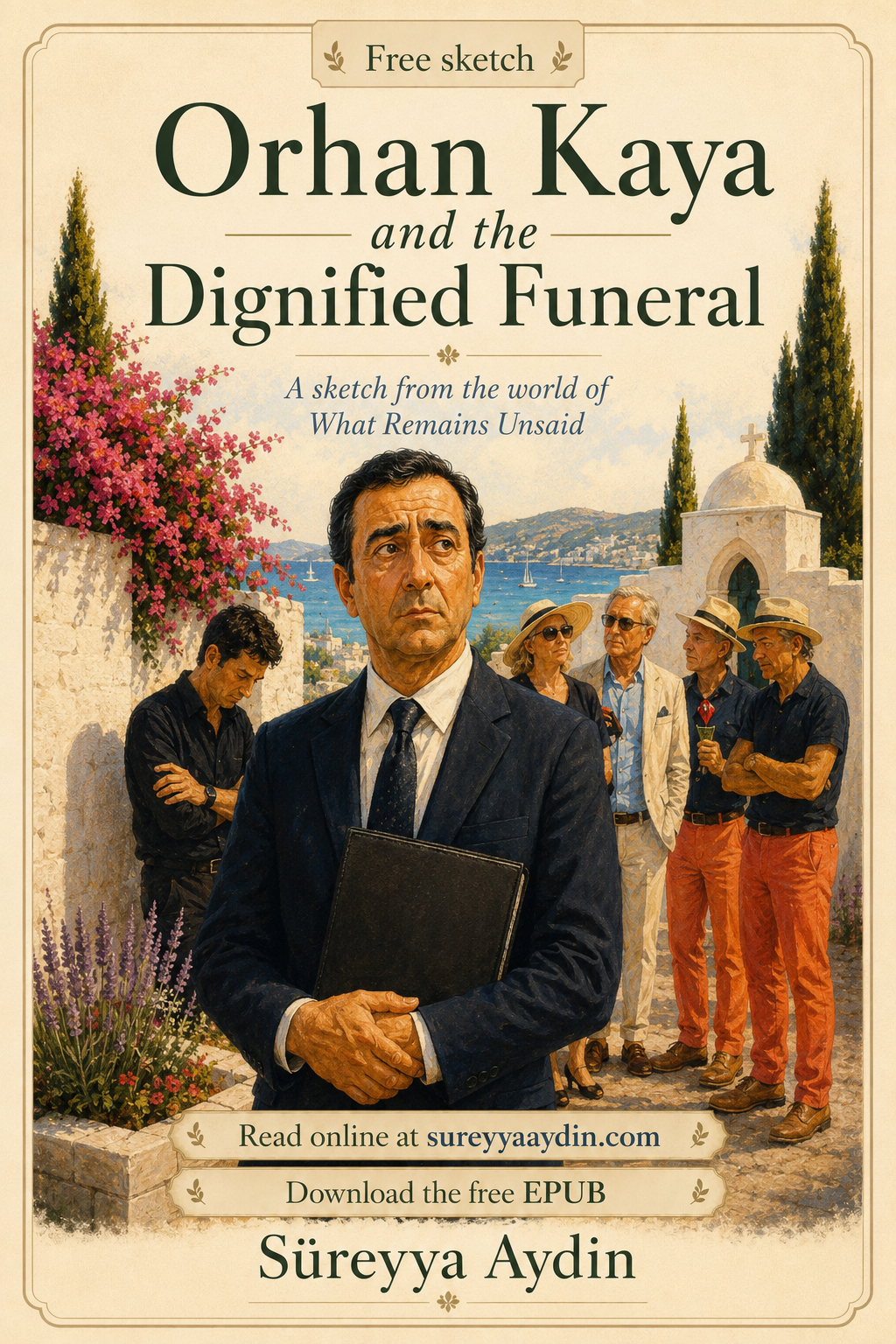
Orhan Kaya and the Dignified Funeral
A short Bodrum sketch from the world of What Remains Unsaid
Practical details prove less obedient.
Orhan Kaya had always believed that death, when properly organised, could be made dignified.
Eamonn Flaherty proved him wrong before lunch.
The news came to him at the Belediye Café, where he was explaining to Raşid that Torba did not have gossip so much as the irresponsible circulation of unverified information.
Raşid, who had known Orhan long enough not to interrupt too soon, listened with patience.
At that moment Kemal appeared at the edge of the terrace.
Kemal had not dressed properly. His collar had folded inward, and his face had the pale, flattened look of a man who had walked too quickly through shock.
‘Orhan abi,’ he said.
Orhan stood at once. Before he knew the facts, he knew the shape of them.
‘Kemal. Sit down.’
Kemal did not sit. His eyes moved once towards Raşid, then back to Orhan.
‘Eamonn is dead.’
The café itself paused. A spoon rested against glass. A chair scraped softly. Somewhere beyond the road, a dog barked and was answered.
Raşid lowered his tea.
‘Başın sağ olsun,’ he said.
Kemal nodded, but the words reached him from a distance.
‘Heart attack,’ he said. ‘In the early hours of the morning. An ambulance came. Nothing could be done.’
Orhan buttoned his jacket. He was not related to Eamonn Flaherty. He was not, strictly speaking, responsible for him. But responsibility, like damp, had a way of spreading in Torba.
‘Have you informed his family back in Ireland?’ he asked.
‘Not the wife. No. Michael has been told. I expect he will inform the other two.’
‘I expect they will fly over immediately.’
‘Yes. I expect so.’
Orhan’s mind began arranging itself into lists.
‘Good. That is proper. There must be sons at a father’s funeral, even if his wife is reluctant to make the journey.’
Kemal’s mouth moved slightly, not quite a smile.
‘I have never met any of Eamonn’s family.’
Raşid glanced at him but said nothing.
‘And Eamonn’s wishes?’ Orhan asked.
Kemal folded his hands together. They were shaking.
‘He always said he wanted to be buried in Torba Cemetery,’ he said. ‘As close as possible to Fatma Girik.’
Orhan straightened. ‘Fatma Hanım was a respected resident of Torba.’
‘Yes,’ Kemal said. ‘Eamonn loved famous actresses.’
‘That is not the same thing,’ Orhan replied.
‘To Eamonn it was.’
Raşid looked into his tea with the expression of a man deciding not to assist.
‘And he always insisted that he did not want to be buried wrapped only in a white sheet, as is customary here,’ Kemal added. ‘He was very clear about that. He wanted to be buried in a proper coffin. Along with the photograph.’
Orhan paused. ‘What photograph?’
Kemal lowered his voice. ‘The signed one. Boy George.’
Raşid turned towards the bay, shoulders lifting once.
‘This is a funeral,’ Orhan said carefully. ‘Not a display cabinet.’
‘It was his wish.’
Orhan took out his phone and opened the notes app. He typed: priest, cemetery, coffin, sons, belediye, transport. After a moment’s hesitation, he added: photograph.
Kemal watched the list forming.
‘There are things at the house,’ he said. ‘Documents. Papers. A safe.’
‘First,’ Orhan said, ‘we attend to the funeral.’
‘Yes, but the safe, Orhan abi…’
‘The funeral,’ Orhan repeated, more gently but with force. ‘Everything else follows.’
Kemal looked down.
In Orhan’s experience, grief often made people attach importance to objects that had no place in the sacred sequence. It was understandable. It was also disorderly.
He added one final word to his list: dignity.
By the time they reached Eamonn’s house, word had already begun its journey.
This was not because anyone had gossiped. It was because Torba had a natural sensitivity to disturbance: a gate left open too long, a doctor’s car outside a house, Kemal walking down the road without sunglasses. By the time Orhan arrived, Ferhunde and Selma were already at the gate, both wearing the expression of women who had come only to help and fully intended to understand everything.
‘We came as soon as we heard,’ Selma said.
‘Heard what, exactly?’ Orhan asked.
‘That something had happened,’ Ferhunde replied. ‘Which it has.’
Raşid, who had followed his sisters from the café at a discreet distance, arrived behind them.
Ferhunde turned to him at once. ‘What happened?’
Raşid lowered his voice. ‘Eamonn Flaherty is dead.’
Ferhunde began to cross herself, stopped, and converted the movement into an adjustment of her necklace.
‘Allah rahmet eylesin,’ she said. ‘Poor man.’
Raşid murmured that there was also a signed photograph of Boy George, which Eamonn wanted buried with him.
Selma tightened her hold on her handbag. ‘Surely one cannot just put Boy George into a coffin.’
‘It is only a photograph,’ Raşid said.
‘That is still someone,’ Selma replied.
Raşid opened his mouth.
Selma closed her eyes. ‘Please don’t make it worse.’
‘This is not a social visit,’ Orhan warned.
‘Of course not,’ Selma said.
‘We are here out of respect,’ Ferhunde added, already looking past him into the hallway.
Eamonn’s house had always been a place people discussed after leaving it. From outside, it looked like any other well-kept Torba villa. Inside, it was unmistakably Eamonn.
A plaster copy of Michelangelo’s David stood in the hallway. Another guarded the drinks cabinet. A third occupied the downstairs bathroom, where Ferhunde later admitted she had found it difficult to wash her hands without feeling supervised.
The sitting room carried the remnants of a life arranged for effect: fringed lamps, heavy glass ashtrays, cushions in colours that had not sought permission from one another, and framed photographs of Eamonn on terraces, boats, in restaurants, outside government offices and, once, inexplicably, beside a cement mixer.
His records stood in polished crates beneath the shelves: ABBA, George Michael, Queen, Boy George, and enough others to suggest not a collection, but a position.
‘He once arranged to have a canvas framed for a lady in Torba,’ Kemal said. ‘Three hundred pounds sterling. I know for a fact the shopkeeper only wanted six hundred Turkish lira.’
Raşid paused. ‘Was the canvas very complicated?’
‘Not particularly.’
This was the difficulty with Eamonn Flaherty. He had made himself indispensable in Torba, which was not the same as being loved. His Irish-accented Turkish had carried half the expatriate community through residency renewals, tapu offices, hospital corridors and building permits.
Eamonn rarely asked for a fee in plain language. Instead, prices acquired soft edges around him. A quote became rounder after he had translated it. A favour became expenses. Not illegal. Not always unfair. But never entirely transparent.
Raşid looked at Kemal. ‘Did this happen often?’
Kemal did not answer.
On the low table lay a notebook, half open. Orhan saw names, numbers, initials, several question marks, and the words ‘Brian, pool tiles, still owes?’ written in blue ink.
He closed it gently.
‘We should not interfere with papers.’
Kemal turned at once. ‘There are more papers in the safe.’
Ferhunde looked up.
‘Safe?’
‘In the bedroom.’
‘Papers?’ she repeated, with the careful neutrality of a woman who had already imagined several things that were not papers.
Kemal’s face tightened. ‘Some legal. Some private.’
Raşid moved towards the window and became interested in the view.
Orhan raised a hand. ‘Later.’
‘But the sons,’ Kemal said.
‘We will receive them with dignity.’
‘They may not want dignity.’
‘Everyone wants dignity at a funeral,’ Orhan said.
No one answered, which answered him.
The bedroom, at the back of the house, was not restful: pink tulle, dusky velvet, a gilt mirror, colognes, cufflinks, and two framed photographs, one of three boys in school uniforms, the other of Eamonn and Kemal laughing at a restaurant.
The safe sat inside the wardrobe, half concealed behind folded linen.
Ferhunde noticed it immediately. ‘It is much larger than I expected.’
‘Ferhunde,’ Selma said.
‘I only meant, for documents.’
Orhan closed the wardrobe door. ‘The safe will remain closed until the sons arrive.’
Kemal took this like a blow. ‘He told me there were arrangements.’
‘Then we shall see them at the proper time.’
‘Proper for whom?’ Kemal asked.
No one answered. Orhan lowered his voice. ‘Kemal, today we arrange the funeral. There is a sequence.’
‘Sequence,’ Kemal repeated. ‘Eamonn hated sequence.’
Orhan began making calls from the terrace.
The first priest could not come. The second number was no longer correct. The third priest was reached through a woman in İzmir who gave Orhan the number with great confidence.
He could come to Bodrum on Wednesday afternoon, around four.
In Bodrum, death did not usually wait politely for Wednesday. Orhan thanked him with the grave politeness of a man accepting defeat while pretending it was arrangement.
When he returned inside, everyone was watching him.
‘The priest will come on Wednesday,’ he announced.
Selma received this as a small foreignness added to the funeral.
‘Wednesday?’
‘Yes.’
‘But that is two days.’
‘Catholic procedure,’ Orhan said, though he was not entirely sure it was.
Ferhunde sat down. ‘So, what happens until then?’
Nobody answered.
That was the danger. In an ordinary funeral in Bodrum, grief had momentum. Here, there would be time for the sons, the expatriates, the rumours, the claims and the safe.
Kemal looked towards the bedroom again.
‘Wednesday,’ he said.
‘It gives us time to organise properly,’ Orhan replied.
Raşid glanced at the plaster David by the drinks cabinet.
‘That may be optimistic.’
By late afternoon Kemal’s phone was filling with messages: some shocked, some practical, and some plainly checking that Eamonn was definitely dead.
Orhan took the phone gently from Kemal and set it face down on the table.
‘No more messages for now. We proceed calmly.’
At that precise moment, Orhan’s own phone rang. He looked at the screen, straightened, and stepped outside.
‘The municipality,’ he said. ‘This is Orhan Kaya. I am coordinating the arrangements.’
Inside the house, Kemal spoke briefly on his own phone.
‘The three sons are flying out tomorrow,’ he said when he returned. ‘Via Istanbul.’
Ferhunde moved closer to Selma.
‘Do you think the sons will cry?’
Selma looked towards Kemal, then towards the closed bedroom door.
‘I don’t know.’
Raşid, still by the window, said quietly, ‘I wouldn’t count on it.’
Kemal heard him. His face changed, not with surprise, but with fear. He looked towards the closed bedroom door, as if the safe had joined the conversation. Then he pressed his fingers hard against his eyes.
No one spoke.
The plaster David by the drinks cabinet looked on, serene and unhelpful.
The sons arrived the following evening in better spirits than Torba considered appropriate.
This was not immediately obvious to Orhan, who met them outside Eamonn’s house in his dark suit, folder under one arm, prepared to receive foreign grief on behalf of the town.
Instead, Michael Flaherty stepped out of the taxi, stretched his back, looked up at the house, and said, ‘Well. He certainly didn’t die under-furnished.’
Brendan, who followed with two suitcases and a duty-free bag, glanced at the plaster David visible through the hallway.
‘No danger of that.’
Conor, the youngest, paid the driver, thanked him in careful Turkish, then turned to Kemal.
For a second, the comedy in the air thinned.
‘You all right?’ Conor asked.
Kemal looked as if he did not know how to answer.
‘I am managing.’
‘That sounds like no.’
Michael came forward next. He shook Kemal’s hand first, then kissed him on both cheeks because he understood the theatre of arrival.
‘Thanks for calling,’ he said. Kemal nodded. There was no embrace. Orhan noticed this. Selma, watching from behind the lace curtain, noticed it more.
Brendan put down the duty-free bag. ‘Did he make a fuss at the end?’
Kemal stared at him.
‘What? Dad never left a restaurant without a scene. I’m asking medically.’
‘No,’ Kemal said. ‘It was quick.’
‘Right,’ Brendan said. ‘Good.’
Orhan stepped forward.
‘Gentlemen. On behalf of Torba, please accept our condolences.’
Michael turned to him with professional courtesy.
‘Thank you. You must be Orhan Bey.’
‘Kaya,’ Orhan said. ‘Orhan Kaya. I am coordinating the arrangements.’
‘God help you,’ Brendan said.
Michael gave him a look.
‘Sorry,’ Brendan added. ‘I mean, thank you.’
The sons were tired from travel, but they were not distressed. This unsettled Selma. Instead of standing in silence, Michael examined the hallway, Conor looked through the photographs, and Brendan stood beneath the David by the key bowl and said, ‘I see he found himself.’
Raşid translated this for Ferhunde as, ‘Eamonn became more himself here.’
Ferhunde narrowed her eyes. ‘That is not what he said.’
The sons moved through the house like men returning not to a home but to evidence.
In the sitting room, Michael paused before a photograph of Eamonn on a boat, one arm around Kemal, the other lifted like a man making an announcement.
‘That’s him,’ Michael said. ‘Making sure everyone knew he was on the boat.’ Brendan laughed.
‘They are laughing,’ Selma whispered.
‘Irish sadness,’ Raşid said confidently, though he was inventing this.
Kemal had not joined the laughter. He stood near the drinks cabinet, his eyes moving too often towards the bedroom corridor.
Michael saw. ‘You mentioned a safe.’
‘Yes.’
‘We’ll look at it after the funeral.’
‘But there may be papers,’ Kemal said.
‘There are always papers after men like Dad die,’ Michael said. ‘That was half the problem.’
Conor stepped in. ‘We’ll deal with it properly.’
‘Legally, if you prefer,’ Michael said.
Kemal did not prefer.
Orhan, sensing disorder, opened his folder.
‘The priest has confirmed tomorrow at four o’clock. The cemetery has been informed. We will gather here beforehand and leave the house by half past three to walk together. The coffin will arrive directly at the cemetery. Afterwards, there will be a gathering here at the house, with tea and refreshments.’
‘Tea,’ Brendan said.
‘Yes.’
‘And drink?’
Selma stiffened.
‘Afterwards,’ Orhan said.
‘After the burial?’
‘Naturally.’
‘Not before?’
‘Certainly not.’
Brendan looked at Michael.
‘Dad would consider that a hostile act.’
‘Dad considered most things a hostile act if they happened before his first drink,’ Michael said.
Conor had moved towards the record crates.
‘He kept them all.’
Kemal’s voice softened. ‘Of course he kept them.’
Conor bent down. ‘ABBA. George Michael. Dusty. Donna Summer. Queen.’ He lifted one sleeve. ‘Boy George. That tracks.’
‘He wanted music afterwards,’ Kemal said.
Orhan turned. ‘What kind of music?’
Kemal hesitated.
‘Dancing Queen.’
There was a silence.
Selma, who had been arranging tea glasses, set down a teaspoon with care.
‘At the house?’ Orhan asked.
‘At the wake,’ Brendan said.
‘The gathering,’ Orhan corrected.
‘The wake,’ Brendan repeated.
Orhan wrote something in his folder that might have been music and might have been no music.
‘We shall consider appropriate volume.’
Michael glanced at Brendan.
‘That’ll be a first for this family.’
By the following morning, the day of the funeral, news of Eamonn’s death had travelled well beyond Torba. By late morning, his gate had begun to open and close with the rhythm of a public office.
The first to arrive were not the closest friends. They were the most practically affected: a woman with a residency appointment, a couple looking for a folder marked tapu, and an elderly woman who brought flowers before asking whether Eamonn had mentioned her curtains.
‘Curtains?’ Selma said.
‘He knew a man,’ the woman replied.
Ferhunde watched from the corner of the sitting room. ‘This does not feel like mourning.’
‘No,’ Raşid said. ‘It feels like office hours.’
Bobby arrived shortly after noon with Pat.
He wore a pale linen jacket and carried no paperwork, which immediately raised him in Orhan’s estimation. He kissed Kemal on both cheeks, held his shoulders for a second, and said, quietly enough that only those nearby heard, ‘He was impossible. But he was never dull.’
Then he let him go before sympathy turned into performance.
Michael came over. ‘You must be Bobby.’
‘I must,’ Bobby said. ‘And you’re Michael. You’ve got his eyebrows, you poor sod.’
Pat turned to Michael. ‘Ignore half of what he says. The difficulty is knowing which half.’
‘We had the same problem with Dad,’ Michael said.
Brendan smiled. ‘I think we’ll get on.’
Orhan relaxed slightly. Bobby was not simply loud. He had the more unsettling gift of noticing what everyone else was pretending not to notice, and saying it first.
The Dutch couple arrived next, tall, composed, and dressed in matching bright orange trousers. For several seconds nobody questioned the trousers at all. Then Selma saw them and stopped speaking.
‘Oh,’ Ferhunde said.
The trousers were not merely orange. They were national.
Pieter and Hans kissed Kemal, embraced the sons, and produced a bottle of something clear and northern European-looking.
‘For afterwards,’ Pieter said.
‘After the burial,’ Orhan replied, intercepting it.
Edmund arrived last, elegant, mournful and scented; he carried a velvet pouch of fragrance samples because, he explained, grief had a terrible way of clinging to clothes.
Ferhunde accepted one politely.
‘Is it medicine?’
Raşid translated Edmund’s answer as ‘emotional disinfectant’.
‘Very modern,’ he added.
By mid-afternoon, the gathering had escaped any category Orhan could recognise. Laughter kept breaking through, and Brendan was explaining that Eamonn had wanted to live on Mykonos in white linen until Mykonos saw his bank balance and sent him to Bodrum.
‘He never meant to stay in one place long,’ Michael said.
Conor, still beside the record crates, did not look up.
‘He stayed here.’
Michael’s face closed slightly.
‘Yes. Eventually.’
Kemal heard this and turned away.
For all the noise, his position in the room had become more isolated. The sons were not unkind, but they were unmistakably sons. They had the legal force of blood, surname, and old injury. Kemal had the keys, the daily habits, the knowledge of which cup Eamonn used in the morning and which pills he forgot at night. None of these, he knew, necessarily amounted to inheritance.
The safe remained closed but had begun to exert influence from the bedroom. Ferhunde had announced, twice, that she had no interest in its contents, which had not prevented her from knowing exactly which wardrobe contained it.
Bobby, passing the hallway, paused. ‘That the famous safe?’
‘There are documents inside,’ Kemal said.
‘Never doubted it,’ Bobby replied. ‘Documents cover a wide field.’
Orhan intervened. ‘The safe will not be discussed until after the funeral.’
‘Fair enough,’ Michael said. ‘After the funeral.’
To Kemal, the phrase sounded like a door being locked from the other side.
The day continued.
Orhan made three more calls to confirm the priest, two to confirm the timing of departure from the house, and one to the cemetery, in which he used the word burial several times, the word Catholic twice, and the phrase coffin arriving directly once while also asking about parking. This reassured him, because arrangements, once spoken aloud, acquired the dignity of certainty.
At three o’clock, Brendan asked suddenly, ‘Where is he now?’
This silenced the room more effectively than any appeal from Orhan had managed.
‘At the morgue,’ Kemal said. ‘They said because of the heat.’
Brendan rubbed his face.
‘Right. Of course.’
Ferhunde leaned towards Raşid. ‘What happened?’
Raşid lowered his voice. ‘He forgot the arrangements.’
‘Raşid!’
‘What? It is practical grief.’
When the conversation resumed, it did so more softly.
Orhan seized the lull.
‘We should begin preparing,’ he said. ‘We leave at half past three.’
Bobby looked at Pat.
Pat gave him a warning glance.
He said nothing.
This, Orhan thought, was a hopeful sign.
Outside, the afternoon light had begun to fall across the terrace. Inside, Eamonn’s house held sons who had stopped expecting anything from him, a companion afraid of being edited out, neighbours determined to be respectful while missing nothing, and expatriates waiting to see what Eamonn Flaherty had left behind.
From the sitting room, very quietly, Conor put on a record.
It was not Dancing Queen. Not yet.
Even Orhan, listening from the hallway, understood that some forms of disorder required rehearsal.
At half past three, Orhan arranged them outside the house: family first, Kemal close enough to be included, Turkish neighbours behind them, expatriates wherever they could be persuaded to stand.
‘We will proceed together,’ Orhan said.
They set off slowly. Too slowly, in Orhan’s view.
The road to the cemetery was not long, but grief, curiosity and inappropriate footwear had made the pace ceremonial in ways he had not authorised. Selma walked with her handbag clasped in both hands. Ferhunde kept turning to check whether Pieter and Hans’s orange trousers looked less orange in shade, which they did not. Edmund had fallen into conversation with Michael about scent and weather. Bobby and Pat walked near the back, though Bobby’s voice travelled forward with unnecessary efficiency.
Orhan looked at his watch.
‘At this speed, Eamonn might arrive at the cemetery before we do.’
‘Eamonn was always early,’ Bobby said, appearing beside him.
‘Was he?’ Orhan asked, grateful for a normal fact.
‘Always. He’d arrive early on purpose so he could have a couple of glasses of wine before everyone else got there.’
‘That is not unusual.’
‘Then he’d put them on the bill so everyone else paid for them.’
Orhan looked at him.
The laughter travelled forwards through the group, followed by several nods of recognition.
Bobby shrugged. ‘It was very Eamonn.’
‘Dad would have wanted a car to the cemetery,’ Brendan remarked.
‘Dad would have wanted a gold Rolls-Royce,’ Michael said.
‘Only if there were witnesses,’ Conor added.
Kemal walked alone for several paces, then Conor slowed until they were side by side. Nothing was said.
The coffin had not, in fact, arrived before them. This troubled Orhan, though not excessively. Transport in Bodrum operated according to principles that were never fully written down, and he had confirmed the timing twice. He had also spoken to the cemetery that morning, repeating the words burial, Catholic, family, priest and dignity with such care that he felt the matter had become secure.
He had mentioned that the coffin would arrive directly, while also asking about parking. In his mind, this had confirmed everything. In the cemetery’s mind, as would become apparent, it had confirmed only the route.
At the cemetery gates, the group loosened.
This always happened at thresholds. Even solemn people needed somewhere to put themselves. The Turkish neighbours moved instinctively towards the shade. The expatriates gathered in small uncertain clumps. The sons looked around with the weary interest of men encountering, at last, the physical location of a decision their father had made years earlier without consulting them.
‘So this is it,’ Brendan said.
‘Apparently,’ Michael replied.
‘Near the actress?’
Kemal looked up.
‘As close as possible,’ he said.
Michael followed his gaze across the cemetery.
‘He would.’
‘He admired her,’ Kemal said.
‘Dad admired anyone who had managed better lighting than him.’
The priest from İzmir arrived almost at the same moment as the coffin.
For Orhan, the priest and coffin arriving almost together was a restoration of order so complete that he nearly forgave the previous twenty-four hours.
The coffin was lifted. Conversation ceased. Even the expatriates quietened. Orhan breathed. All might yet be dignified.
Then he heard an English voice behind him.
‘I’ll be honest,’ one of the expatriate men murmured to another. ‘I only came to make sure he was actually dead.’
‘And?’
‘Jury’s still out until I see him lowered.’
Orhan turned his head slowly.
The men fell silent.
The priest opened his book.
The service began.
It was brief, formal and recognisably solemn. The priest’s voice carried well in the dry afternoon air. The sons stood without fidgeting. Kemal’s face had become unreadable. Selma watched carefully, respectful but alert to variations.
Raşid whispered, ‘This is going well.’
Orhan did not answer. One did not congratulate a funeral while it was still in progress.
The priest closed his book. The men moved towards the grave.
And stopped.
The pause was not dramatic at first. It was practical. One cemetery worker looked at the coffin. Another looked at the grave. A third bent slightly, assessed width, depth and consequence, then straightened with the grave expression of a man who had discovered that the dead had arrived in the wrong format.
Orhan saw the problem before he accepted it.
The grave was prepared. The coffin was prepared. The two were not prepared for one another.
The cemetery men had dug according to the custom they knew. The sons had brought the coffin their father had requested. Between these two certainties lay Eamonn Flaherty, still causing trouble by refusing to fit the available category.
‘What’s happening?’ Selma whispered.
Raşid stared.
‘I think,’ he said slowly, ‘there is a question of dimensions.’
Ferhunde went pale with interest.
‘Dimensions?’
‘Depth. Width. Possibly both.’
Selma looked away, then looked back, because not looking had proved impractical.
At the graveside, men had begun to confer. Not loudly. Not disrespectfully. But with the urgency of people who wished their bodies to solve what language had failed to prevent. The coffin was moved slightly. The grave was inspected again. Someone made a measuring gesture with both hands. Someone else suggested, in Turkish, that perhaps if it were angled.
Michael heard the word angled.
‘No,’ he said.
‘No what?’ Brendan asked.
‘Whatever they’re suggesting, no.’
The priest lowered his book by an inch.
Orhan moved forward.
‘There is no difficulty,’ he said.
Every face turned towards the grave.
‘There is a small practical adjustment.’
Bobby looked into the hole.
‘That’s not a small practical adjustment,’ he said. ‘That’s a planning dispute.’
‘Bobby,’ Pat said quietly.
‘What? I’m only saying.’
Conor ran one hand over his mouth. Kemal stood rigid, his eyes fixed on the coffin. Brendan looked from the grave to the coffin and then, fatally, to Bobby.
Several men attempted to test the angle by sight alone. A spade was called for. Then another. A cemetery worker disappeared at speed.
The priest waited.
Orhan’s knees loosened.
This, he understood, was how reputations ended. Not through corruption, not through scandal, but through insufficient width.
The silence grew.
Bobby, who had been watching the measurements with unusual seriousness, said, ‘Has anyone got a tub of Vaseline handy?’
The pause was so complete that even the cypress trees withdrew.
Then Brendan made a noise into his fist.
Michael turned away.
Conor’s shoulders lifted once, then again.
Pat said, ‘Bobby, for God’s sake,’ turning away because she was laughing too.
The two expatriate men who had come to verify Eamonn’s death dissolved first. Pieter and Hans followed, not loudly, but helplessly. Edmund pressed a handkerchief to his mouth. Someone near the back muttered, ‘He’d have loved this,’ which made matters worse.
The Turkish mourners remained frozen.
Ferhunde looked at Raşid. ‘What did he say?’
Raşid resisted, failed, and translated as carefully as the situation allowed.
Ferhunde stared at him, then at the coffin, then at the grave.
‘At a burial?’ she said.
Selma looked away, but not before Raşid made a sound he could not defend. Then another. Ferhunde looked outraged until her own mouth twitched.
Orhan saw this with horror.
The laughter spread not because anyone intended disrespect, but because intention had become irrelevant. The coffin, the grave, the waiting priest, the orange trousers and the failure of measurement had formed a fact too large for solemnity to contain.
Kemal did not laugh.
This, for a moment, restored Orhan’s faith in grief.
Then Brendan, still bent over, said, ‘He always did like a tight entrance.’
Kemal made a sound.
It was not laughter at first. It was too cracked for that. He put one hand over his eyes and gripped Conor’s sleeve with the other. Conor steadied him. Kemal shook once, then again, and the sound became laughter, wet and unwilling and terrible.
Nobody mocked him.
The laughter softened around him.
Michael put a hand on his shoulder.
‘Sorry,’ he said, though it was not clear to whom.
Kemal shook his head, still covering his face.
‘He would have said worse.’
‘Much worse,’ Brendan said.
Bobby nodded. ‘And somehow still have sent us the bill.’
The priest looked towards the cemetery gate, where the gravediggers were returning at speed with tools.
‘Perhaps,’ he said, with a mildness that startled them all, ‘we might allow the men to correct the matter.’
Brendan looked at him.
‘Was that an Irish accent I just heard?’
The priest glanced down at his book.
‘Only when necessary.’
Michael looked at him.
‘You’re Irish?’
There was a second pause.
The priest looked into the middle distance, as if remembering a former life with mixed feelings.
‘County Mayo,’ he said.
Brendan stared at him, then began laughing again.
Orhan felt the day slipping beyond recovery.
The gravediggers worked quickly and with admirable seriousness, which was more than could be said for most of the mourners. Jackets were removed. Earth was moved. The coffin waited with an air of patient accusation.
After five minutes, Michael produced a small silver flask from inside his jacket.
‘What is that?’ Orhan asked.
‘Whiskey.’
‘At the grave?’
‘For shock.’
‘Whose?’
Michael looked around. ‘At this stage, everyone’s.’
The flask passed from brother to brother, then to Kemal, then to Pat. When it reached Orhan, he raised both hands.
The priest watched with professional uncertainty until Brendan noticed him. ‘Father?’
The priest hesitated. ‘Only a little.’
He took a sip. ‘That is not bad.’
‘It’s from Dublin airport,’ Michael said.
The priest resumed his place.
His voice, when the service continued, remained steady, though warmer. The coffin was lowered, this time without difficulty. No one made another joke. Even Bobby stood silent, his head bowed, Pat beside him and looking, for once, as if she was not preparing to correct him. Kemal watched the coffin descend with the stricken focus of someone seeing the practical end of his life with another person. The sons stood beside him, not tenderly, exactly, but close enough.
Earth was placed. Prayers were completed. The priest closed his book.
For a brief moment, the funeral regained itself.
Then Brendan produced a second flask.
‘To Dad,’ he said.
Michael lifted his.
‘To Eamonn. Impossible in life. Logistically complicated in death.’
The priest, now holding a small plastic cup someone had found from nowhere, inclined his head.
‘May he rest in peace.’
Bobby added, ‘And not require further adjustment.’
‘Bobby,’ Pat said.
But the priest was laughing.
As the proceedings broke apart, Ferhunde somehow ended up beside Pieter and Hans.
‘In Turkey,’ she told them, ‘we eat afterwards.’
‘That is sensible,’ Hans said. ‘Also, how do you make such perfect rice?’
‘The rice must be washed properly. Otherwise it becomes sticky.’
‘Rice must be free,’ Hans said.
‘Not free,’ Ferhunde corrected. ‘Separate.’
‘Like grief,’ Pieter said.
Ferhunde considered this. ‘No. Like rice.’
The invitation back to Eamonn’s house spread without any single person issuing it. Michael said there would be drinks. Brendan said there would be music. Conor asked Kemal whether he wanted to go back first. Kemal said yes, though returning to the house seemed to frighten him more than the cemetery.
Orhan intended to decline on behalf of Turkish propriety. Then Ferhunde said, ‘We should go, of course. It would be rude not to.’
‘Rude?’ Selma said.
‘They are inviting us.’
‘They are inviting everyone.’
‘Exactly.’
‘Very well,’ Orhan said. ‘We may attend briefly.’
‘Briefly,’ Ferhunde agreed, in the tone of a woman who had no such intention.
Behind them, the gravediggers smoothed the earth over Eamonn Flaherty with professional efficiency. In life he had made a living from other people’s complications. In death, he had provided one final example.
Orhan walked back towards the house, folder under his arm, aware that something had happened to the word dignity and that he would not, for some time, be able to restore it to its former shape.
By the time they returned to Eamonn’s house, the wake had already begun without admitting it.
This was partly because nobody could agree what else to call it. Orhan persisted with gathering. Brendan said wake. Michael said drinks. Conor said nothing, which was perhaps the most accurate term available. Selma, when asked by a neighbour what was happening, said there would be refreshments, but with a hesitation that suggested refreshments might no longer be sufficient to describe the situation.
Someone had opened the drinks cabinet. The sons moved through the room with the practised energy of men who had spent the day not grieving and now required a recognised substitute. Edmund arranged fragrance samples by mood. Pieter and Hans stood near the terrace doors with Ferhunde, who had moved from discussing pilaf to discussing börek.
Selma watched from the edge of the room.
‘Since when does she teach Dutch people to cook?’
‘Since the funeral became international,’ Raşid said.
On the dining table, the food had gathered with less dignity than the mourners: börek, olives, pastries, crisps, and pork products brought back from Kos with the guilty confidence of contraband.
Selma noticed them immediately. ‘What is that?’
Raşid looked once, then looked away.
‘I think it may be pork.’
Selma stared at the plate.
‘At a funeral?’
‘Apparently after a funeral.’
‘Very well,’ she said, granting the pork products temporary residency.
The priest from County Mayo had returned too, which surprised Selma more than anything that had happened at the cemetery.
‘Is he allowed?’ she whispered.
‘To stay?’ Raşid asked.
‘Yes.’
‘He is Irish.’
Bobby raised his glass.
‘To Eamonn. He’d help you out of a hole, then charge you for the ladder. But he’d bring the ladder. That was the thing.’
The sons laughed. So did several expatriates. Kemal did not laugh, but his mouth moved. For the first time since the cemetery, the expression was not fear.
‘To Eamonn,’ Michael said.
They drank.
Michael opened the record crate. He put on George Michael first, and the room loosened by degrees.
Then Conor found the right record.
Kemal saw the sleeve before anyone spoke. His face altered.
‘Not yet,’ he said.
Conor paused.
Michael looked at Kemal, then at Brendan.
‘Let him choose.’
Kemal stood very still.
‘He always played it too loud,’ he said.
‘Then we’ll play it too loud,’ Brendan replied.
Orhan opened his mouth.
Selma said, ‘No, Orhan Bey.’
He closed it.
The first notes of Dancing Queen filled the room.
Nobody moved. The song was too bright for the hour, too young for the dead, too shameless for the house. Then Kemal laughed once and covered his mouth.
‘He would stand there,’ he said, pointing towards the terrace doors. ‘With one hand like this.’
He lifted one hand in an exaggerated flourish.
Brendan copied it. ‘Like this?’
‘No. Worse.’
‘Show us.’
Kemal shook his head. Then, under an old household law, he began to move.
Not well. Not freely. But the room made space around him, and then the sons joined because resistance had become more foolish than participation.
Ferhunde watched Kemal turn, one hand in the air, tears still visible on his face.
‘He is crying.’
‘Yes.’
‘But dancing.’
‘Also yes.’
While the room turned towards the music, Michael touched Brendan’s arm. Conor saw the look too. Kemal did not; he was laughing now, not happily, but with the helplessness of someone pulled into a memory before he could defend himself.
The three sons left the sitting room by degrees. Orhan noticed, because Orhan noticed most things involving procedure.
‘Where are you going?’
‘The safe,’ Michael said.
‘Now?’
‘After the funeral, you said.’
Orhan looked towards Kemal.
‘Should he not be present?’
Brendan glanced over. ‘He’s occupied.’
‘That is not a legal answer.’
‘No,’ Michael said. ‘But it is a humane one.’
Orhan hesitated. ‘I will come.’
‘Of course you will,’ Brendan said.
They went down the hallway.
Ferhunde saw them leave.
She waited five seconds, which she considered restraint, then handed her glass to Selma.
‘Where are you going?’ Selma asked.
‘Napkins.’
‘There are napkins on the table,’ Selma said.
‘Clean ones.’
‘Those are clean.’
‘Cleaner ones,’ Ferhunde said, and followed.
The bedroom looked different with music coming from the other end of the house. Less theatrical, perhaps, because the theatre had moved elsewhere. In the half-light, the four-poster bed, the pink tulle, the velvet curtains and the gilt mirror looked less like decoration than evidence of a man who had spent years refusing to become smaller.
The safe sat in the wardrobe.
Michael had the key code.
Orhan looked at him.
‘His solicitor in Dublin had a copy of a letter,’ Michael said. ‘Mostly instructions. Some of them wrong. But there was a key code.’
Michael opened the safe.
They all leaned forward.
Inside were envelopes, passports, old residency papers, title deed copies, several sets of keys, a bundle of euros held together with an elastic band, two watches, a notebook full of names and amounts, and a signed photograph of an improbably handsome young man no one immediately recognised, but no one mistook for paperwork.
Orhan cleared his throat.
‘That looks private.’
Michael lifted an envelope.
‘Kemal.’
The room changed.
Conor moved closer. Brendan stopped smiling. Even Orhan, who had been preparing himself for documents, understood that this was no longer quite a matter of documents.
Michael opened it, read the first line, then lowered the paper.
‘Money?’ Brendan asked.
‘Some. And a letter addressed to Kemal.’
For a moment, no one moved.
From the sitting room came the bright, impossible sound of the music and Kemal’s laughter inside it.
Orhan looked towards the door.
‘Then he should be told.’
‘He will be,’ Michael said.
It was said firmly enough to close the question.
The safe had become serious.
Then Brendan, who had been looking beneath a folded silk scarf, stopped moving.
‘Oh.’
Michael looked over, put one hand against the wardrobe and began to laugh.
Brendan lifted the scarf no higher than necessary.
There were several objects beneath it. Their exact purpose did not need to be declared. They had the polished, specialised look of things sold behind frosted windows.
Orhan looked once, then immediately at the ceiling.
From the doorway, Ferhunde said, ‘Are those medical?’
All four men turned.
She stood very still, wearing the expression of a woman who had come for napkins and found evidence.
‘I was looking for napkins,’ she said.
‘In the bedroom?’ Orhan asked.
‘I had not yet found them.’
Orhan closed his eyes briefly.
Ferhunde looked once more, long enough to confirm that this was not a medical category.
Michael lowered his head again. Brendan had turned towards the wall.
The silence continued.
Ferhunde adjusted her sleeve.
‘I already have sufficient information.’
This was not true, but it had the advantage of dignity.
From the sitting room, the music changed. Someone had put on another ABBA record. A cheer rose, followed by Bobby’s voice saying something indistinct and Pat saying, more distinctly, ‘No, Bobby.’
Michael folded Kemal’s envelope and set it apart from the rest.
‘We tell him later,’ he said. ‘Not in front of everyone.’
They closed the safe.
They returned to the sitting room to find the wake enlarged beyond recovery. Someone had found YMCA. Edmund was demonstrating restrained arm movements near the drinks cabinet; Pieter and Hans were not restrained at all; the priest from Mayo was clapping in time with the calm authority of a man who had seen worse in parish halls.
Kemal was laughing. Not freely. Not without damage. But laughing.
Orhan still stood near the doorway with his faithful folder under one arm. It had been present at the house, the cemetery, the grave, the whiskey and the safe. It now looked faintly absurd.
Michael noticed. ‘Put the folder down, Orhan Bey.’
‘I am perfectly comfortable.’
‘You’re at a wake.’
‘Gathering.’
‘You are at a gathering where the priest is drinking whiskey and my father has just been buried with Boy George. Put the folder down.’
Slowly, Orhan set the folder on a side table beside the fragrance samples.
Edmund glanced at it. ‘Very administrative. Top notes of anxiety.’
Then YMCA reached the part where even people who claimed not to know the song knew what was expected of them.
‘Come, Orhan,’ Raşid said. ‘For international relations.’
‘I do not know the movements.’
‘Nobody here knows the movements,’ Selma said.
‘That is not true,’ Bobby called. ‘I know them beautifully.’
‘That is what concerns me,’ Pat said.
Orhan watched Kemal, Ferhunde, the sons, the priest, and the plaster David by the drinks cabinet.
Something gave way in Orhan. He stepped forward.
The first movement was wrong. So was the second. By the third, it no longer mattered.
Kemal heard Brendan say, ‘Now that would have frightened Dad,’ and laughed again, wiping his face with the back of his hand.
Ferhunde leaned towards Raşid, slightly out of breath.
‘I have changed my mind,’ she said. ‘An Irish funeral has advantages.’
‘You disapproved of it an hour ago.’
‘That was before I understood the structure.’
‘There is a structure?’
‘Of course. First, prayer. Then whiskey. Then confusion. Then dancing.’
Raşid considered this.
‘That is not so different from a wedding.’
Ferhunde nodded.
‘Except with more honesty.’
Later, Orhan would maintain that the funeral had been dignified in all essential respects. There had been a priest, prayers, a coffin eventually accommodated, farewell, earth and respect. The flasks, the question of width, Bobby’s suggestion and the safe were details no sensible person would emphasise.
But Orhan knew the truth. Eamonn Flaherty had not left behind a dignified silence. He had left sons who laughed because bitterness had long ago dried their tears, a companion who danced because grief had nowhere else to go, and objects that refused to behave.
It had not been orderly.
It had not been solemn.
But as Orhan watched Kemal, pink-faced and unsteady, dancing beneath a plaster David while Ferhunde tried to follow the next movement and Selma pretended not to smile, he understood that the day had achieved something more difficult than dignity.
It had been accurate.